Friday, 13 March 2015

Yumi Kori : "windowspace" - one day intervention

YUMI KORI
15 March 2015


Yumi Kori is an artist and architect based in New York and Tokyo. She works within the context of places, transforming them by altering architectural settings through installations and interventions. By using light and sound to discover new spatial and temporal dimensions, Kori's projects set out to discover what is hidden in exiting/entrance areas of a space.

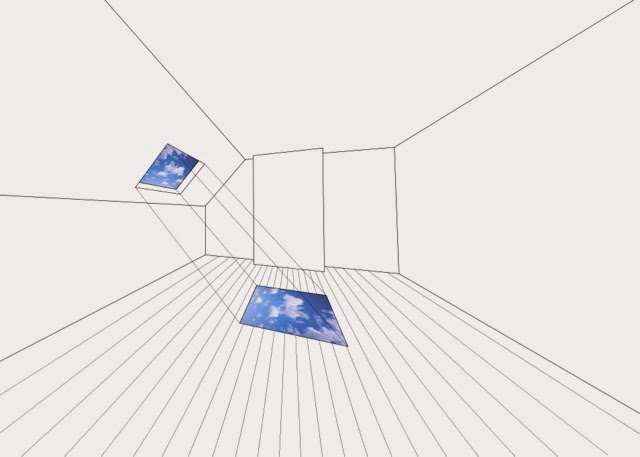
Kori presented "windowspace" which focused on the two main windows in the Platform 102.  The intervention gave viewers an example of what is framed from this perspective by erasing our peripheral vision and capturing each moment passing as a frame, thereby generating ideas about the area outside the space....within it.


image: study for window space
© Yumi Kori / Platform 102

 image: Yumi Kori

image: "windowspace", 2014
© Yumi Kori / Platform 102

About:
Yumi Kori received a MS in Architecture from Columbia University, 1995 and a BA in Architecture, from Kyoto Prefecture University, 1983. She is currently a Lecturer at Tokyo University of Science, and Kokushikan University, Tokyo. 

Solo projects have been presented at: Queens Museum of Art, New York, The National Art Center, Tokyo, 2014; The Mattress Factory, Pittsburgh, USA, 2010 and 2003; MAM, Museum of Modern Art Bahia, Salvador, Brazil, 2008; Kobe Biennale, 2007; and COCA, Center on Contemporary Art, Seattle, 2005.

Group projects include: Interdisciplinary Festival for Music and Sound Art, Vienna, 2013; Elga Wimmer Gallery, New York, 2009; ART PROSPECTS, New York, 2009; and Mu Project Gallery, Washington DC, 2007. This will be Kori's first solo presentation in Europe.

Visit the artist's website at: http://www.studio-myu.com/art/
back>> platform102.org/previous.html

Wednesday, 11 March 2015

Ermias Kifleyesus

PLATFORM 102

ERMIAS KIFLEYESUS 
Public view 
8 February 2015

Private viewing by appointment 10 February - 12 March 2015

For his presentation at Platform 102 Ermias Kifleyesus presented works that expand upon the artist style which has been 15 years in the making – showing a strong commitment to the studio, to the process of looking, re-worked concepts and experimentations with the public.

"Untitled"; 2014
(© Ermias Kifleyesus)

Kifleyesus created a conversation within Platform 102 enabling the viewer to understand the deep sense of community used to create each piece. At the same time, the presentation expresses his own identity through his engagement in creating the work. A process that includes random public actions which at times seems playful, but are steeped in art history, social politics and contemporary ideas about materials and form. 

presentation view :Ermias Kifleyesus
(© Platform 102)

His observances of the most ubiquitous and mundane actions expresses a determination to find order and meaning in the chaos of found and emotionally or memory-charged material. This provides for the presentation to have a singular language, expressing itself as a form of expanding the boarders of contemporary practice into an insightful creative intimacy with the assistance of the public.

Kifleyesus is an artist whose terrain lies along interface of culture and place/ment. Works are an overlaying of things international, anonymous and personal. That fact alone makes Kieflyesus one of the most interesting emerging artists practising in Brussels today.
 
                                                                                                                                           orc


"You Can Never Go Home Again, But the Truth is You Can Never Leave Home. (Maya Angelou)"; 2014
(© Ermias Kifleyesus)

presentation view :Ermias Kifleyesus
(© Platform 102)

Ermias Kifleyesus is presented courtesy of Kusseneers Gallery (Brussels).

About:

Ermias Kifleyesus (b. Addis Abeba, 1974) holds a diploma from the Addis Ababa Fine Art School, Ethiopia (1997), a Masters in Arts from City and Guild of London Art School, UK (2004) and is a laureate of HISK, Gent, (2009).  Solo exhibitions of his work have been held at "The Solo Project", Basel, (2014); "Humidity and the mystery of traces" Kusseneers Gallery, Brussels (2014) and "Materials", Harlan Levey Projects, Brussels, 2013. Group exhibitions include "Biennale of Painting", Museum Dhondt-Dhaenens, Deurle, 2014; "Do You Know Who I Am", MUHKA, Antwerp, "Shame!", PianoFabriek, 2013 and "Intimacy", Fribourg, 2013

back>> platform102.org/previous.html

Saturday, 13 December 2014

Kurt Ryslavy

PLATFORM 102

KURT RYSLAVY
Public View
14 December 2014

Private viewing 17 December 2014 - 25 January 2015

A sonorous and low-pitched voice is speaking insistently the following text (en/ fr/ nl – recorded tape)......

Kurt Ryslavys artistic practice could be defined as an exploratory journey into the sensory experience of reality. Using different devices – installations, projections, immersive environments, urban interventions, sculptures –, he invites the viewer to cross the threshold into a new sensory space, on the borderline of dizziness and bedazzlement. In a register inspired by cognitive processes, his works tend toward a certain minimalism, underscoring the fleeting, ephemeral or fragile character of what he is proposing. Spatialization and distribution of light, radiant colour, and translucent or reflective surfaces all serve to reveal the instability of our perception of time and space. Properties of matter (gloss, lightness, transparency, fluidity) and physical phenomena (reflection, refraction, perspective, balance, waves) are rigorously investigated for their ability to destabilize the very concept of materiality.


Kurt Ryslavy produced objects made by shrink-wrapping transparent plastic mineral water bottles around hand-painted found wood logs. Ryslavy used a small Bunsen-burner as his heating source and white and red wine was served during the duration of the performance.

After the completion of each object he asked one of the spectators to hold it while it’s still warm. There was a cardboard (80 x 120 cm) with the artist name stencilled on it where the spectators can place the object, if they don’t what to keep holding it.


After the performance - 10 objects will be produced – the audience will be informed (by  the poster next to the exit) that the spectators can keep one object if they buy a box of 6 bottles of wine. The bill for the wine will serve as the certificate of authenticity (10 proforma this evening – original bill will follow by post/ mail).

Immersive Environment was part of the artist presentation at Platform 102. There are several objects shown in variations (Morceau de Bois, peint rouge& coupé (09), Painting Salesman 03 (9 boxes + 1 box) winebottles, facture décorative 347 serie noir (incl. installation on spot & windowshape {as reference}), and two painted wine bills (facture décorative mono 111 le monochrome avec son arrière-plan économique), and three artist books/ editions.

The generous opportunity to take an object home for free, after having purchased 6 bottles of wine should will conclude at the end of the opening (19h - 14/12/2014). The ten boxes (6 bottles) of 10 different wines next to the entrance have different prices. The first visitor who buys a box has the best price selection. For example it would not be possible to order 6 bottles with the order form and take a free object home afterwards.


About:
 
back>> platform102.org/previous.html


Wednesday, 19 November 2014

Object Based Performance - November 16, 2014

Saori Kuno 
"Reciprocal Action; You guess you know what they are"  


more information at: ello.co/object-based-performance

What is Object Based Performance?

Object Based Performance is a curatorial project studying artists who use visual items as distinctive parts of their performances and/or those artists who create items to initiate participatory actions.  Contemporary performance artists who have developed practices defining classification/categorization of the object within and outside of the performance will be presented by Platform 102 using a wide range of resources, institutions, and public spaces.

Object Based Performance is organic in its research approach. Most of the artists selected have used objects in their work for some time while a new generation of artists  are examining new approaches and media to contemporary performance. 

Platform 102 will use social media sites for updates, announcements and occasional commentary . The objective of the project is to expand the concept of the performance/performer into the discourse of visual art practice.

Image: Objects from "Reciprocal Action; You guess you know what they are"  
            Saori Kuno - November 16, 2014 
            image (© Saori Kuno/Platform 102, Brussels)


Thursday, 6 November 2014

SAORI KUNO

PLATFORM 102

SAORI KUNO
Public View
16 November 2014

Private viewing by appointment 19 November - 9 December 2014

Saori Kuno's recent work is the result of a series of operations and rearrangements of easily acquired materials. By exaggerating the composition of manufactured items Kuno presents reinterpretations of everyday aesthetic simplicity through a conceptual framework.

© Platform 102

Her work is generally presented either off-set, in groups or overlapping. Kuno's presentation at Platform 102 created a visual dialogue between materials and form, between things organic and manufactured, which drives her practice. 

© Platform 102

Kuno presented a new version of her performance piece "Reciprocal Action; You guess you know what they are" on-site during the public view.  Objects from the performance remained at Platform 102 for temporary private view. 

© Platform 102

Kuno's performance served as part of the Platform 102 curatorial project "Object Based Performance" (OBP). OBP examines artists who use visual items as distinctive parts of their performances and/or those artists who create items to initiate participatory actions.  Kuno along with other selected artists examining social concepts with objects and performance will be presented throughout the 2014-2015 season. 
                                                                                                                                                   orc


About:

Saori Kuno (Japan, °1983) works on the transduction of materials and situations by using simple-playful strategies of the system and formats for everyday practices, aesthetics and values. Her series of objects and installations are composed by simple materials, industrially produced parts and products which are submitted to reproducible processes with integrative meanings to reflect upon. She holds a Master of Research in Art and Design from St. Lucas University College of Art & Design Antwerp, Belgium (2014). Her works has been exhibited at Basis (Frankfurt); Marres (Maastricht);  MUHKA (Antwerp); Royal Academy of Fine Art (Antwerp) and Extra City (Antwerp). This is first solo presentation of Kuno's work.

back>> platform102.org/previous.html

Friday, 10 October 2014

Tramaine de Senna

PLATFORM 102

TRAMAINE de SENNA
Public View
28 September 2014

Private viewings by appointment 30 September  thru November 2, 2014 

V.O.M. = VAGUE OBJECT MOTIFS, CERAMIC SERIES / Tramaine de Senna

The motivation for the VOM series of work stemmed from my initial fascination of surfaces and decoration. I view the surface and form of things as the container of histories, experiences and stories that led up to its appearance and “attitude” - which is the outward manifestation of the interior. Having moved abroad to further my studies, of course, things become new again: I had new eyes. Reflection of myself and America, the country I grew up in, and the phenomena of how things manifested within this country, appeared itself to me.

In particular, I started to look at an era - a heavy era - between the two world wars where the Western world was visibly entering into modernity: the surfaces of things were being cleansed and streamlined. Buildings were designed to look like machines. Steel and glass. The International Style. No décor on the surfaces of things, no more vernacular white-washing, baroque ornateness, sensuality in lines and curves, et cetera. The advancement of science and progress, of chemicals and hygiene rubbed off onto civilian of life. For instance, window sills in hospitals: it is easier to clean a smooth, white surface, which equally signified hygiene in the mind of the observer, than a wooden window sill complete with its architraves and jambs. As also with the use of white t-shirts under the modern suit. The erection of this white “screen” signified hygiene and the physical body, with its contours and warmth, became an idea, a space within the mind. This also takes on the issue of class, or those who could afford to buy and maintain these types of clothes, and those who's sweat and labor cleaned and manufactured these commodities.

  "V.O.M. #3", Ceramic; 2013
(© Tramaine de Senna/Platform 102, Brussels)

There are two distinct World's Fairs within the Unites States, which hold significance for me: the World's Columbian Exposition of 1893 in Chicago with its white plaster city and the 1939 New York World's Fair with its hope for the future. Where the white plaster city of Chicago emulated Western Europe, the 1939 New York Fair held its own distinct look and identity. Observing how cities are planned, whether organically, from a grid, or as a radial, initially America has leaned towards borrowing aesthetics from across the Atlantic for weight and meaning in defining itself as a republic with history. Just look at any state or federal building. Its architecture alludes to classical Greek and Roman architecture, which then borrows itself from ancient Egypt like that of the Temple of Karnak, and so forth.

With the 1939 New York Fair an aesthetic of the future, not the past, defined a new era for America and the world. This again, has a lot to do with the military industry. The aerodynamics of planes, bombs and bullets, rubbed off onto civilian and domestic life. Industrial designers created sheaths for trains, giving theses machines the appearance of cyclops roaring through landscapes. Cars grew sensuous curves too. Yet, things that had nothing to do with aerodynamics and speed also took on this appearance and therefore the idea of speed: desk lamps, fans, barometers, even women's brassieres. The surfaces of things that were streamlined and cleansed of superfluous décor in fact became an aesthetic, a decoration.

For these interests, I was compelled to create this V.O.M. series. 

"V.O.M. #2", Ceramic; 2012-2013
(© Tramaine de Senna/Platform 102, Brussels)

Technically speaking, the V.O.M. Ceramic series are slip-cast earthenware. This technique of slip-casting is usually employed in making smaller objects which hold not so much volume, such as cups and plates. This technique is also used for porcelain production. The three distinct shapes are of my own design, which came from studying this era as described above, and then boiling down a basic essence of shape and form. First, the object (positive) had to be designed and made in clay which was destroyed in order to reach the second step: a plaster mold (negative). From the plaster mold, a hollow plaster positive was constructed within it, which was the third step. The plaster mold, or negative, was then destroyed to take out the plaster positive form. This plaster positive was then wet-sanded to obtain a smooth surface, which almost appeared non-porous when water was sprayed onto its surface. From there, the forth step of creating a three- or four- part massive plaster mold (negative) around the hollow plaster form was taken. This massive plaster mold was also wet-sanded on its interior surfaces because it would serve as the “mother” to the slip-cast earthenware objects – the positives. The fifth step involved pouring liquid clay into the mother molds. As the liquid clay rest within the mother molds, the plaster would absorb the water from the liquid clay, leaving a skin along the mother's interior, wet-sanded surfaces. After 1.25 hours, the liquid clay was poured out, and a hollow form (positive) was left. These positives had to then dry for at least 1 – 2 weeks, where then fired, sanded, and then glazed. Glazing required the surface to be free of dust, hand-prints and any oils from the hand. For glaze, I either calculated and mixed my own non-lead chemicals, or purchased it. I then sprayed on the glaze with a pistol, then fired the objects again for a second time.

   Installation view

"V.O.M" Series, Ceramic; 2012 - 2013
(© Tramaine de Senna/Platform 102, Brussels)

back>> platform102.org/previous.html


Saturday, 6 September 2014

Benjamin Patterson - Stop Sitting on the Fence

PLATFORM 102 in cooperation w/ Harlan Levey Projects

Benjamin Patterson: Stop Sitting on The Fence 
Curator O. Rynell Cash - Platform 102
5 September - 12 October 2015

A trip to Cologne, Germany in 1960 and an unpleasant meeting with composer Karlheinz Stockhausen are what lead to the ideas of social art practices in Benjamin Patterson's works. Patterson traveled to Cologne to attend the International Society for Contemporary Music Festival.. Patterson recalls the meeting  as "negative" and decided to  go to another festival that was an off-festival of Stockhausen's  held at the studio of Mary Bauermeister called the Contre Festival. Once there, Patterson met other young aspiring composers and artists such as John Cage, Nam Jun Paik, and George Brecht. Patterson was asked to perform the next evening with Cage and Paik in what is now known as the unofficial start of Fluxus, artist projects and ideas most active in the late 1950s and early 1960s. Patterson's one week stay in  Cologne turned into a year and half residency in Europe.

© Platform 102

Although happy to have met like-minds at the Contre Festival the meeting with Stockhausen had more of an affect on Patterson as an artist as well as an experimental composer. Patterson went into a three day isolation period to think of ways to make more "socially responsible art." The result of this socially self-imposed isolation was Paper Piece (1962), one of the defining Fluxus works that includes either selected performers or audience participation. The first actual performance of Paper Piece was in the form a letter sent to his family in Pittsburgh for them to perform. Patterson’s motivation from then on would be to make art with a social context and to take risk with his practices and compositions.

But what precisely does Benjamin Patterson draw out of his motivations by transforming them into art? Is it the feeling of the theorist that he seeks? Or is it to invite conversations about our similarities and differences? Could it be that Benjamin Patterson strikes a quintessential nature of contemporary practice that redirects our attention to the interpretation of modern truths and necessities in times of social discord?  

The exhibition Benjamin Patterson: Stop Sitting on the Fence uses a juxtaposition of Patterson's concepts within his visual art and performance practices to address aesthetic values relate to social conditioning. Although a broad subject to cover in a gallery exhibition and through one artists career  the works selected span several decades and range from printmaking, sculpture, performance documentation, and assemblage pieces giving an overview of a lifetime career.   

The exhibition title relates to a statement made by Patterson in a self conducted interview titled " I'm Glad You Asked Me That Question" where he responds to the times in which most early Fluxus works were created. There was great political upheaval in the United States at this time essentially with Civil Rights movement. Patterson felt this was not a time when artists should just sit on the fence.

EXHIBITION

With an immediacy and effortlessness that contradict their cleverness, the works that make up the exhibition «Stop Sitting on the Fence» are observations on both Patterson and society in all its diversity. And quirky indeed are these observations with the right visual weight and wonkiness to express the intimate and humanity.  Indeed, for Patterson society has enhanced what being creative means. His visibility internationally allows a sense of fellowship not only to Fluxus but to the public which are essentially his work.

The exhibition is in two parts. The entrance of the gallery serves as a study of the Patterson's approach to life and Fluxus ideologies. Installed in the back gallery are works that are presented to create discussions and address overcoming challenge. The selected works in the back gallery are to reacquaint the viewer with certain aspects of existence related to objects.

The first images you encounter as you enter Harlan Levey Projects are three photographs that document Patterson's performative work. The first photograph is of the artist performing "Variations for Double Bass" at the Ecole Nationale des Beaux-Arts in 1989.  Next to it is a photograph of Patterson performing "The Clinic of Dr. Ben (BM,MS)" as part of a Fluxus festival in Wiesbaden, Germany. They serve as brief introductions to some of the essential works in Patterson's enormous repertoire of performance practices.

To the left of these two photographs sits a gallery copy of Patterson's "The Black and White File 1958-1998" which chronicles all the artist performances and scores from this period. The two originals are bound in a black binder with photocopies. It is a reflection of the artist work and shows the of ideas over three decades. Above the Black and White File 1958-1998  is a black and white photograph from Patterson's performance of "A Clean Slate" performed in Frankfurt where the artist uses a chalkboard to create a random score on site.

© Platform 102

Confronting you with the idea of suggestion in the centre of the gallery is 'Sit Down" . The assemblage work is simple in its construction; a white chair with an extension and a stuffed toy bear with a collar that invites the viewer into a conversation. The conjunction here, between the concrete, the speculative and the real space of the sculpture plays into fluxus ideals of instruction as art. 

«Swiss Symphony II» consists of a pendulum clock that has a crossbow attached in front a print of Salvador Dali's "William Tell". The work demonstrates the artist need for play as well as connectivity to contemporary ideas. He takes a rather ordinary and familiar object as a clock and mixes it with humour ,dialogue, art history and familiarity making it a work more about advancing creative process through visual means.

A multiple work by Patterson from his recent performance at the Nassauischer Kunstverein in Wiesbaden, Germany titled "Dr. Ben's Fluxus Medicine Show" is a presentation of "elixirs" that come with documentation and an explanation of the brain and art. At the performance I witnessed in May 2014 Patterson enters the room where he is dressed in a doctors jacket with a medical chart. Behind him is a woman acting as a  nurse in what I can best describe as the fantasy nurse, the one every guy in the movies wants walking in his room. Tight fitting uniform, white leggings, high-heels. Patterson proceeds to explain the science and theories behind why people like contemporary art. He then ask members of the audience if they would like have a neurological examination that would result in a print-out  which he then reads and gives his diagnosis. The performance is humorous in its approach to explain art history an use past ides of other Fluxus artists (Yoko Ono, Dick Higgins, Allison Knowels) to initiate their thoughts about contemporary work. 

Next is Patterson's "Marble Hat"  representing Patterson's first solo exhibtion in Europe in 1962.  The exhibition was held at French poet and artist Robert Filliou's Galerie Legitime which was Filliou's hat. For this exhibition Patterson and Filliou went on a 24hour excursion around Paris and presented versions of Puzzle Poems by taking off Filliou's hat. All the works sold in the 24 hour time period. Marble Hat is a play on remembrance, chance operations, the idea of communication and the transformation of the kitsch into an aesthetic.

© Platform 102

The "Puzzle Poem" adjacent to Marble Hat is one of  two poems the artist didn't include in his first exhibition. It is made up of five reservable pieces with different images on each side which are whimsical in their text yet honest and direct in visual vocabulary about politics and identity. This shift in Patterson's work  sets the tone for the work installed in the office space of  documented performances on video and works that are more raw and grounded in their simplicity.

Dialogue is shaped differently in the second-half of the gallery with works that give the everyday a gentle sculptural tweak and rare paintings by the artist. The works here revolve around deliberate placements to make  composition on how objects and time help define progress in western society. Because most of the works are made from found objects, this is not straight forward ideas. This transformation of the found from kitsch to philosophical requires a keen eye and requires a certain level of self-consciousness, which is exactly the sort of artist Patterson is.

On the back wall is Patterson's assemblage work «Candyland». It deals with the gap between meaning, words and objects and the fragile nature of communication. It reregisters the nature of reality through common boardgames and toys, reserving for us the concept that all attempted searches for meaning leave us somewhat entertained and rejuvenated but never replaces individual realities. Along the same line you have "Uncle Ben's Arte Shoppe" a dispense machine that offers trinkets, at the price of $4.98. Patterson uses satire and deadpan humour in this work while also revealing underlying truths and universal philosophies of wants and desires....at a price. One cannot actually retrieve an trinket leaving the object with a sense of wonder.

Rheingold, a map created by the artist marking a performance where he mined for gold in the River Rein marking the areas where gold was actually found. The performance lead to additional project for gallery spaces where audience participation was necessary. Next to Rheingold are Patterson's "Ski Poles (from Climbing Mt. Fuji)." The work is what the artist says they are, the actually  ski poles he used to climb Mt. Fuji on his 70th Birthday as part of a performance tour. He repeated this climb, shy of just two hours to the peak this past spring to celebrate his 80th birthday. Both works demonstrate a knowing and playfulness that Patterson applies to his practice and the act of taking on challenges which he feels are important to art and life.

Lastly, we have a series of paintings by the artist that depict the weather patterns over  several days in early October 2006. The images are taken from the weather reports for Europe in the International Herald for this time. While working on this series, ironically  the Herald decided to change their layout and weather report design so Patterson decided to stop a process that could have ongoing. 

© Platform 102
Benjamin Patterson w/ guest at opening
© Platform 102

back>> platform102.org/previous.html


Wednesday, 28 May 2014

Patrick Wokmeni - Guest Artist


PLATFORM 102

PATRICK WOKMENI
Public View
1 June 2014

Private viewings by appointment:  4 June through 20 July 2014 


Curator's Statement:

Patrick Wokmeni is a political artist through cultural experience. First, his photographs address his society which is a by-product of European colonialism. Secondly, Wokmeni has developed (if not created) his own style of photography through a practice of research, process and visual commentary. In addition, Wokmeni is a witness and documentarian (of sorts) of the after affects of colonialism in Cameroon which is a reflection of colonialism period both in his homeland and by those who choose to migrate into Europe either by choice or through necessity.

Wokmeni's story into the world of art and photography has many romantic overtones. He left school at age fifteen to help support his family in Douala by working at a local hotel where he met French filmmaker Anne Chabert who was working on a project. Chabert hired the untrained Wokmeni as one of her videographers and also gave him a camera to take still images. Wokemeni fell in love with photography and begin to use his upbringing in New Bell (a district of Douala) as his subject matter for his photographs, particularly the nightlife of the area. From this point his interest in social issues which affected his friends and contemporaries became important in his process and personal growth as a photographer. This self-taught practice of Wokmeni's is not held down by academic theories of contemporary photography. He's not looking for the perfect photograph as much as the perfect moment which reflects a viewpoint relative to his own upbringing and explores the conditions of a society and the illusions created within it, addressing ideals of celebration while also exploring the rigorous and destructive methods post-colonialism still can have within a culture. 

In a question and answer section from "Portrait of the Artist. Works and References" (HISK, 2013), Wokmeni was asked what his idea of success is. His eloquent and direct answer was "work". And "work" he has! Since being given a camera at age fifteen Wokmeni took photography seriously and it became part of his daily life, as well as, his career. He sought-out, learned from and worked with noted photographers Bruno Boudjelal, Bill Akwa Betote, Philippe Niorthe and Nicolas Eyidi. He taught himself the process of developing a style and submitting work for exhibitions. He began to research photographers such as Nan Goldin and the work of fellow Cameroonian conceptual artist Goddy Leye (1965-2011) who he felt had similar theories to his own. There is a lot more in between then and now in Wokmeni's practice but between then and now he has become recognized as one of the leading young photographers from the African continent along with the likes of Sammi Baloji, Ananias Leki Dago and Abraham Onoriode Oghobase. His work has been included in numerous international exhibitions at reportable exhibition spaces and events such as BOZAR, (Brussels), Savvy Contemporary, (Berlin), Dak'Art Biennale (2010) and the Marrakech Biennale (2014). In addition, he became a HISK Laureate in 2013. Unlike his contemporaries in the post-graduate program Wokmeni doesn't posses a graduate degree. His acceptance in the program was based on his "work" as a photographer. 

Thoughts about Works in Presentation

Wokmeni’s photographs are linked directly to his homeland of post-colonial Cameroon. They deal with city life or the migratory routes faced by his friends and fellow Cameroonian's into mainland Europe giving a narrative to the social conditions within his community and a democratic voice in the treatment of his subjects. Selected photographs from two series are being shown for his presentation at Platform 102. 

Three photographs selected from his 2009 series about Hip-Hop culture in Douala focus on different individuals in the movement. Stylistic influences are apparent in each photo where through their simplicity they offer a sense of rebellion. The individuals are present and the viewer has to confront them. This affords the viewer the possibility to understand the extent of their expressions and cultural significance serving as an extension of the Wokmeni's personal viewpoints. You can find thematic similarities to the early photography of Jamel Shabazz who documented early hip-hop culture in nineteen eighties New York City, the time of b-boys and girls. Whereas most of Shabazz's subjects are posed or posturing Wokemeni subjects are shown as they are in the moment. Rather then implicating or allowing an arranged stance he creates photos that are based on documentary truth. This style can also be seen in other series the artist has developed like "Les Belles de New-Bell"(currently on view at Festival Belluard Bollwerk International, Fribourg) which focuses on women in clubs and prostitutes in the New Bell district, and another which is a personal exploration of the artist sex life.

Two large format photographs from the series "Purgatory" (2013) first raise the question of who are the individuals in the photos? Aside for the fact that we are focused on the the subjects we are also witnessing an aspect of cultural upheaval and of being caught in the middle by barricades of trying to immigrate to mainland Europe as an artist. In this series Wokmeni studies friends transition from Cameroon to a detention center in Morocco. One of the subjects is a publish writer/poet and the other a painter. Both names of the subjects are kept anonymous and both photographs in the presentation are untitled. The photographs are not romanticised yet they are poetic in theory and composition. By using a style that combines narrations of transition through non-verbal techniques the viewer is allowed to experience individuals caught between cultural context and political systems.

Patrick Wokmeni's photographs demonstrate how images can give impact to both individual struggle and personal identity. Above all Wokmeni reveals the emotional values of his people which has shaped his technique of cultural activism through photography.

orc


About:  

    "Untitled" from the series "Purgatory", 2013
     (© Patrick Wokmeni)


back>> platform102.org/previous.html

Sunday, 30 March 2014

Philip Janssens

PLATFORM 102

PHILIP JANSSENS
Public View
30 March 2014

Private viewings by appointment: Wednesday 2 April through Sunday 11 May 2014 


Statement:

Platform 102 is pleased to showcase the work of Philip Janssens as its inaugural artist presentation. The show includes works that are presented in different variations and two artist multiples created specifically for the presentation.

Born in Lille, France and working in Antwerp, Berlin and Brussels, Philip Janssens creates artworks in different mediums by intentionally manipulating the perception of objects to create new materials. The "creation" of these materials address issues such as banality and identity in order to offer new perspectives and associations for established recognition of objects and self. Through this multi-disciplinary approach he makes thought provoking works that are as conceptual as they are aesthetically pleasing.

About the works in presentation:

Two works in the presentation are directly related yet are presented in three variations and also three different mediums. "Untiled" (powder) is a combination of finely ground glass and mother of pearl. The method of getting to the right material is a long and (at times) dangerous process.  All types of glass were experimented with to create the right illusion. Janssens then decided to add mother of pearl as an agent to assist in its lure. You can't help but relate its appearance to cocaine and thereby could relate it to the ideas of seduction, addiction in society, etc. This would be a wrong and easy way of interpreting it according to the artist. Janssens says the work was simply seeing how he could make something that was actual and useless at the same time. 

This method is explored in the digital photographs of "Miscellaneous". These two digital photographs which are one complete work are images of "Untitled"(powder) being thrown in the air by the artist in both natural daylight and at night-time. He uses the flash of a camera to demonstrate the light effect of the work while at the same time documenting the fragility and banality of it. While there is an example of the physical work present we know that parts of it have been scattered elsewhere. 

Inside the vitrine with "Untitled" (powder)  is a recently created multiple (edition of 10) of the powder sealed within a bronze tin. With "Untitled" (multiple) the object can not be or should not be opened. If opened the work will scatter because the work is lighter than air as demonstrated in the photographs "Miscellaneous"  so thereby the work is then destroyed, or is it?

The presentation also includes an additional multiple "Untiled" (poster). This poster of silver printed on paper with a text by artist Douglas Parks that speaks to Janssens practice is a take-away version (edition of 60/50 available/10 AP in reserve) of a new multiple that will be produced at a later date in another very limited edition version. The work comes from a sociological perspective of being drawn to image (self) or creating a material to demonstrate ones self. The reverse side (whichever side you take as the reverse) of the poster are both reflective thereby activating the vocabularies of surface, idea and material. One gives an example of the artist who has created the work and one side gives and shows reflection of the viewer in relation to the work.

The final work "Untitled (Blind Spot)" is the second edition of three variations of the same concept. Through his highly sophisticated, yet deceiving low tech sculptural installation, Janssens reminds us that perception is not literal.  He separates the object from its outcome yet the outcome remains essentially its finality as an artwork. The work in a sense represents the melding of installation, sculpture and painting. Janssens assembles objects, space and light to create a modular work that can take on new form and color each time it/they are installed. The works in the presentation represent how simplicity can express complexities.


orc

About:

Philip Janssens studied in Situ3 at the Royal Academy of Fine Arts in Antwerp. Solo exhibitions include Martin Van Blerck Gallery, Antwerp, 2012; BB15, Linz, 2011; Rhok, Brussels, 2008; MuHKA, Antwerp , 2006.  Group exhibitions include: The Gunshot, Galerie Marion De Canniere, 2013,   utopie//toi pue//pie tou LungoMare/ Bolzano, 2012; PPP (Public Private Paintings), MuZee, Oostende, 2011; G58-G59 Mass Akker, Verbeke Foundation, Kemzeke, 2010; Honorons Honoré, De Garage, Mechelen, 2010, Floating Territories / Venice Biennale / Athens Biennale / Istanbul Biennale / Italy, Greece, Turkey, 2007.


    image: Philip Janssens preparing "Untitled" (multiple); 2014
    (© Platform 102, Brussels)

back>> platform102.org/previous.html